a computer that is dedicated to sharing data and managing resources is called what
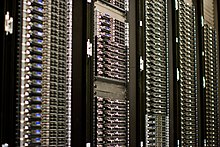

First World wide web server located at CERN with its original sticker that says: "This machine is a server. Do NOT Ability IT Downward!!"
In computing, a server is a piece of figurer hardware or software (computer program) that provides functionality for other programs or devices, called "clients". This architecture is called the client–server model. Servers can provide diverse functionalities, oftentimes chosen "services", such every bit sharing data or resource among multiple clients, or performing ciphering for a client. A single server can serve multiple clients, and a single client can employ multiple servers. A client procedure may run on the same device or may connect over a network to a server on a different device.[1] Typical servers are database servers, file servers, mail servers, print servers, web servers, game servers, and awarding servers.[2]
Client–server systems are usually most frequently implemented past (and often identified with) the request–response model: a customer sends a request to the server, which performs some action and sends a response back to the client, typically with a event or acknowledgment. Designating a reckoner as "server-grade hardware" implies that it is specialized for running servers on information technology. This often implies that it is more than powerful and reliable than standard personal computers, simply alternatively, large computing clusters may exist composed of many relatively simple, replaceable server components.
History [edit]
The apply of the discussion server in calculating comes from queueing theory,[iii] where it dates to the mid 20th century, being notably used in Kendall (1953) (along with "service"), the paper that introduced Kendall's annotation. In earlier papers, such as the Erlang (1909), more concrete terms such as "[telephone] operators" are used.
In computing, "server" dates at least to RFC 5 (1969),[4] one of the primeval documents describing ARPANET (the predecessor of Internet), and is contrasted with "user", distinguishing two types of host: "server-host" and "user-host". The use of "serving" also dates to early documents, such as RFC 4,[five] contrasting "serving-host" with "using-host".
The Jargon File defines "server" in the mutual sense of a procedure performing service for requests, usually remote, with the 1981 (1.1.0) version reading:
SERVER due north. A kind of DAEMON which performs a service for the requester, which oftentimes runs on a figurer other than the 1 on which the server runs.
Operation [edit]

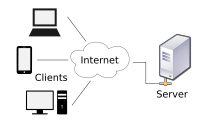
A network based on the customer–server model where multiple private clients request services and resources from centralized servers
Strictly speaking, the term server refers to a computer programme or process (running programme). Through metonymy, information technology refers to a device used for (or a device dedicated to) running one or several server programs. On a network, such a device is chosen a host. In addition to server, the words serve and service (as verb and as noun respectively) are oft used, though servicer and retainer are not.[a] The word service (substantive) may refer to either the abstruse form of functionality, eastward.thou. Web service. Alternatively, information technology may refer to a figurer program that turns a computer into a server, eastward.g. Windows service. Originally used as "servers serve users" (and "users utilise servers"), in the sense of "obey", today one often says that "servers serve data", in the same sense as "give". For instance, web servers "serve [upwardly] web pages to users" or "service their requests".
The server is role of the customer–server model; in this model, a server serves data for clients. The nature of communication between a client and server is asking and response. This is in contrast with peer-to-peer model in which the human relationship is on-demand reciprocation. In principle, any computerized process that can be used or called past another procedure (particularly remotely, peculiarly to share a resource) is a server, and the calling procedure or processes is a client. Thus any general-purpose computer connected to a network can host servers. For example, if files on a device are shared by some process, that procedure is a file server. Similarly, spider web server software tin run on any capable computer, and and then a laptop or a personal computer can host a web server.
While request–response is the most common client-server blueprint, at that place are others, such every bit the publish–subscribe pattern. In the publish-subscribe pattern, clients register with a pub-sub server, subscribing to specified types of messages; this initial registration may exist washed past request-response. Thereafter, the pub-sub server forwards matching messages to the clients without whatsoever further requests: the server pushes letters to the client, rather than the client pulling messages from the server every bit in request-response.[6]
Purpose [edit]
The role of a server is to share data equally well as to share resources and distribute piece of work. A server computer can serve its own computer programs too; depending on the scenario, this could be part of a quid pro quo transaction, or merely a technical possibility. The following table shows several scenarios in which a server is used.
| Server blazon | Purpose | Clients |
|---|---|---|
| Application server | Hosts web apps (computer programs that run inside a web browser) allowing users in the network to run and use them, without having to install a re-create on their ain computers. Unlike what the proper name might imply, these servers do not need to be role of the Www; whatever local network would exercise. | Computers with a spider web browser |
| Catalog server | Maintains an index or table of contents of information that tin can be constitute across a large distributed network, such equally computers, users, files shared on file servers, and spider web apps. Directory servers and name servers are examples of catalog servers. | Any calculator plan that needs to find something on the network, such a Domain fellow member attempting to log in, an email client looking for an email address, or a user looking for a file |
| Communications server | Maintains an environment needed for i communication endpoint (user or devices) to find other endpoints and communicate with them. It may or may not include a directory of communication endpoints and a presence detection service, depending on the openness and security parameters of the network | Communication endpoints (users or devices) |
| Calculating server | Shares vast amounts of computing resources, specially CPU and random-access retentivity, over a network. | Any computer program that needs more CPU power and RAM than a personal computer tin probably afford. The customer must exist a networked computer; otherwise, at that place would be no client-server model. |
| Database server | Maintains and shares any form of database (organized collections of information with predefined properties that may exist displayed in a table) over a network. | Spreadsheets, accounting software, asset management software or virtually any figurer program that consumes well-organized data, particularly in large volumes |
| Fax server | Shares one or more fax machines over a network, thus eliminating the hassle of physical access | Any fax sender or recipient |
| File server | Shares files and folders, storage space to agree files and folders, or both, over a network | Networked computers are the intended clients, even though local programs tin can be clients |
| Game server | Enables several computers or gaming devices to play multiplayer video games | Personal computers or gaming consoles |
| Mail server | Makes email communication possible in the same way that a post office makes snail postal service communication possible | Senders and recipients of email |
| Media server | Shares digital video or digital audio over a network through media streaming (transmitting content in a way that portions received can exist watched or listened to as they arrive, as opposed to downloading an entire file and and so using information technology) | User-attended personal computers equipped with a monitor and a speaker |
| Print server | Shares 1 or more printers over a network, thus eliminating the hassle of concrete access | Computers in need of printing something |
| Sound server | Enables estimator programs to play and record sound, individually or cooperatively | Computer programs of the same computer and network clients. |
| Proxy server | Acts as an intermediary between a client and a server, accepting incoming traffic from the customer and sending it to the server. Reasons for doing so include content command and filtering, improving traffic performance, preventing unauthorized network access or only routing the traffic over a large and complex network. | Any networked estimator |
| Virtual server | Shares hardware and software resources with other virtual servers. It exists merely as divers within specialized software called hypervisor. The hypervisor presents virtual hardware to the server as if it were real physical hardware.[7] Server virtualization allows for a more efficient infrastructure.[8] | Whatsoever networked figurer |
| Spider web server | Hosts web pages. A spider web server is what makes the World Wide Web possible. Each website has one or more web servers. Besides, each server tin host multiple websites. | Computers with a web browser |
Almost the entire structure of the Internet is based upon a customer–server model. Loftier-level root nameservers, DNS, and routers direct the traffic on the internet. There are millions of servers connected to the Internet, running continuously throughout the world[9] and virtually every action taken by an ordinary Internet user requires one or more interactions with one or more servers. At that place are exceptions that exercise non utilize dedicated servers; for example, peer-to-peer file sharing and some implementations of telephony (eastward.1000. pre-Microsoft Skype).
Hardware [edit]
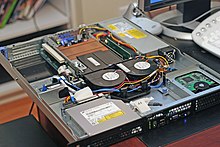
A rack-mountable server with the superlative cover removed to reveal internal components
Hardware requirement for servers vary widely, depending on the server's purpose and its software. Servers are more often than not, more powerful and expensive than the clients that connect to them.
Since servers are commonly accessed over a network, many run unattended without a reckoner monitor or input device, audio hardware and USB interfaces. Many servers do not have a graphical user interface (GUI). They are configured and managed remotely. Remote management tin can be conducted via diverse methods including Microsoft Management Console (MMC), PowerShell, SSH and browser-based out-of-band direction systems such as Dell'southward iDRAC or HP'due south iLo.
Large servers [edit]
Big traditional single servers would demand to be run for long periods without interruption. Availability would have to be very high, making hardware reliability and durability extremely important. Mission-critical enterprise servers would be very fault tolerant and use specialized hardware with low failure rates in order to maximize uptime. Uninterruptible ability supplies might be incorporated to guard against power failure. Servers typically include hardware redundancy such as dual power supplies, RAID deejay systems, and ECC memory,[10] along with extensive pre-boot retentiveness testing and verification. Critical components might be hot swappable, allowing technicians to supersede them on the running server without shutting it down, and to guard against overheating, servers might have more than powerful fans or use water cooling. They volition often be able to be configured, powered up and down, or rebooted remotely, using out-of-band management, typically based on IPMI. Server casings are usually flat and wide, and designed to be rack-mounted, either on 19-inch racks or on Open Racks.
These types of servers are often housed in defended information centers. These will unremarkably take very stable power and Internet and increased security. Dissonance is as well less of a concern, but power consumption and rut output tin be a serious upshot. Server rooms are equipped with air conditioning devices.
Clusters [edit]
A server farm or server cluster is a collection of reckoner servers maintained by an arrangement to supply server functionality far beyond the capability of a single device. Modern data centers are now often built of very large clusters of much simpler servers,[11] and there is a collaborative effort, Open Compute Projection around this concept.
Appliances [edit]
A class of minor specialist servers called network appliances are more often than not at the low end of the scale, ofttimes existence smaller than common desktop computers.
Mobile [edit]
A mobile server has a portable form factor, e.grand. a laptop.[12] In contrast to large information centers or rack servers, the mobile server is designed for on-the-road or ad hoc deployment into emergency, disaster or temporary environments where traditional servers are not feasible due to their power requirements, size, and deployment time.[13] The primary beneficiaries of so-called "server on the go" technology include network managers, software or database developers, preparation centers, armed services personnel, law enforcement, forensics, emergency relief groups, and service organizations.[14] To facilitate portability, features such as the keyboard, brandish, battery (uninterruptible power supply, to provide power back-up in case of failure), and mouse are all integrated into the chassis.
Operating systems [edit]

Dominicus's Cobalt Qube 3; a reckoner server appliance (2002); running Cobalt Linux (a customized version of Red Chapeau Linux, using the 2.two Linux kernel), complete with the Apache web server.
On the Internet the dominant operating systems amid servers are UNIX-like open-source distributions, such equally those based on Linux and FreeBSD,[15] with Windows Server as well having a significant share. Proprietary operating systems such as z/OS and macOS Server are too deployed, but in much smaller numbers.
Specialist server-oriented operating systems accept traditionally had features such as:
- GUI not bachelor or optional
- Ability to reconfigure and update both hardware and software to some extent without restart
- Advanced backup facilities to permit regular and frequent online backups of disquisitional data,
- Transparent data transfer betwixt dissimilar volumes or devices
- Flexible and advanced networking capabilities
- Automation capabilities such every bit daemons in UNIX and services in Windows
- Tight arrangement security, with advanced user, resource, information, and memory protection.
- Advanced detection and alerting on weather such as overheating, processor and disk failure.[sixteen]
In practise, today many desktop and server operating systems share similar code bases, differing mostly in configuration.
Energy consumption [edit]
In 2010, data centers (servers, cooling, and other electrical infrastructure) were responsible for 1.1-1.5% of electrical energy consumption worldwide and 1.7-2.2% in the United states.[17] One guess is that total energy consumption for data and communications technology saves more than 5 times its carbon footprint[18] in the rest of the economy by increasing efficiency.
Global free energy consumption is increasing due to the increasing demand of data and bandwidth. Natural Resources Defense Council (NRDC) states that data centers used 91 billion kilowatt hours (kWh) electrical energy in 2013 which accounts to 3% of global electricity usage.
Environmental groups have placed focus on the carbon emissions of data centers as it accounts to 200 million metric tons of carbon dioxide in a year.
Meet also [edit]
- Peer-to-peer
Notes [edit]
- ^ A CORBA retainer is a server-side object to which method calls from remote method invocation are forwarded, but this is an uncommon usage.
References [edit]
- ^ Windows Server Administration Fundamentals . Microsoft Official Academic Course. 111 River Street, Hoboken, NJ 07030: John Wiley & Sons. 2011. pp. 2–three. ISBN978-0-470-90182-3.
{{cite book}}: CS1 maint: location (link) - ^ Comer, Douglas E.; Stevens, David L (1993). Vol III: Customer-Server Programming and Applications . Internetworking with TCP/IP. Department of Estimator Sciences, Purdue Academy, West Lafayette, IN 479: Prentice Hall. pp. 11d. ISBN978-0-xiii-474222-9.
{{cite volume}}: CS1 maint: location (link) - ^ Richard A. Henle, Boris W. Kuvshinoff, C. M. Kuvshinoff (1992). Desktop computers: in perspective. Oxford University Press. p. 417. ISBN9780195070316.
Server is a adequately recent figurer networking term derived from queuing theory.
{{cite volume}}: CS1 maint: uses authors parameter (link) - ^ Rulifson, Jeff (June 1969). DEL. IETF. doi:10.17487/RFC0005. RFC 5. Retrieved xxx November 2013.
- ^ Shapiro, Elmer B. (March 1969). Network Timetable. IETF. doi:x.17487/RFC0004. RFC four. Retrieved 30 November 2013.
- ^ Using the HTTP Publish-Subscribe Server, Oracle
- ^ IT Explained. "Server - Definition and Details". world wide web.paessler.com.
- ^ IT Explained. "DNS Server Not Responding". www.dnsservernotresponding.org.
- ^ "Web Servers". IT Business organization Border. Retrieved July 31, 2013.
- ^ Li, Huang, Shen, Chu (2010). ""A Realistic Evaluation of Memory Hardware Errors and Software Arrangement Susceptibility". Usenix Annual Tech Conference 2010" (PDF) . Retrieved 2017-01-30 .
{{cite web}}: CS1 maint: multiple names: authors list (link) - ^ "Google uncloaks once-clandestine server". CNET. CBS Interactive. Retrieved 2017-01-30 .
- ^ "Mobile Server, Power to go, EUROCOM Panther 5SE". Archived from the original on 2013-03-17.
- ^ "Mobile Server Notebook". 27 January 2022.
- ^ "Server-quotient Calculator Doubles as a Mobile Workstation".
- ^ "Usage statistics and market place share of Linux for websites". Retrieved eighteen Jan 2013.
- ^ "Server Oriented Operating Organisation". Retrieved 2010-05-25 .
- ^ Markoff, John (31 Jul 2011). "Information Centers Using Less Power Than Forecast, Report Says". NY Times . Retrieved 18 Jan 2013.
- ^ "SMART 2020: Enabling the depression carbon economic system in the information age" (PDF). The Climate Grouping. 6 Oct 2008. Archived from the original (PDF) on 22 Nov 2010. Retrieved 18 January 2013.
Further reading [edit]
 | Wikimedia Commons has media related to Servers. |
- Erlang, Agner Krarup (1909). "The theory of probabilities and phone conversations" (PDF). Nyt Tidsskrift for Matematik B. xx: 33–39. Archived from the original (PDF) on 2011-10-01.
- Kendall, D. G. (1953). "Stochastic Processes Occurring in the Theory of Queues and their Analysis by the Method of the Imbedded Markov Chain". The Register of Mathematical Statistics. 24 (3): 338–354. doi:10.1214/aoms/1177728975. JSTOR 2236285.
Source: https://en.wikipedia.org/wiki/Server_(computing)

Post a Comment for "a computer that is dedicated to sharing data and managing resources is called what"